

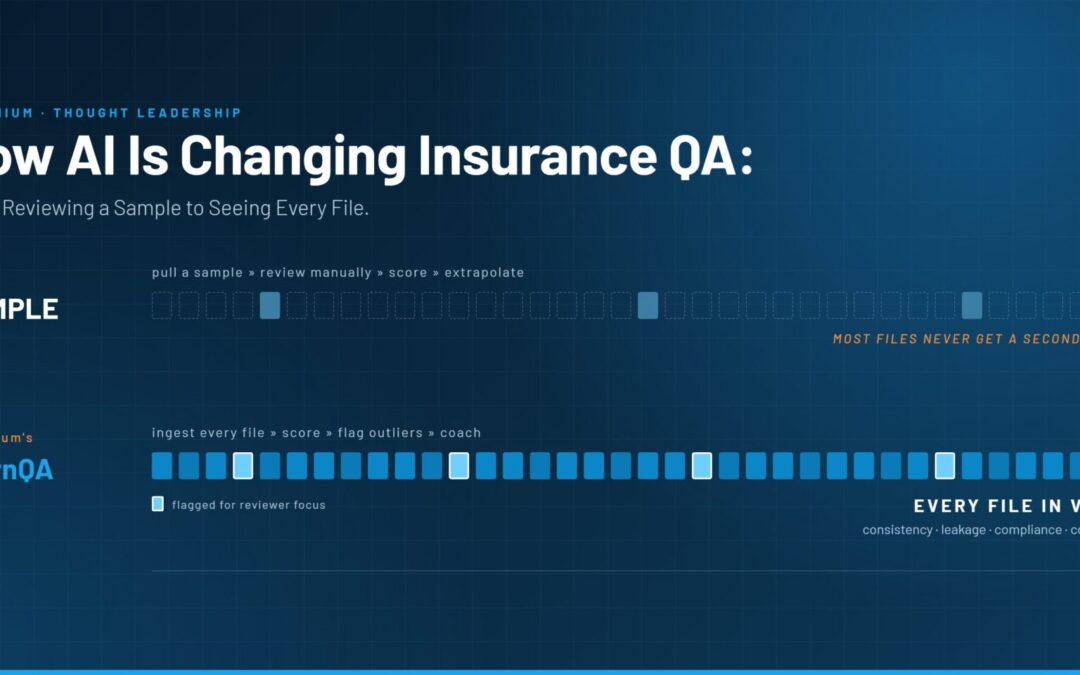
Every QA leader in insurance has made peace with an awkward fact. You’ve built a strong program. Your audit framework is thoughtful. Your reviewers can spot a mishandled file, and still, most files go unread.
That isn’t a people problem. It’s a math problem. Sampled QA was designed for a world where reviewing every claim or underwriting file was impossible. So, we review a small percentage, extrapolate, and report quarterly. By the time a handler's patterns show up in that report, they've been repeated across hundreds or thousands of files and have quietly cost money in leakage, rework, regulatory exposure, or customer experience.
AI-powered QA changes the math. Not by replacing a reviewer’s judgment, but by applying it consistently to every eligible file. Here is what that shift actually means for a carrier, and why the way the AI is built matters as much as the fact that it exists.
From a sample to the whole book
With Athenium’s new AI-native solution, CairnQA, 100 percent of eligible files are evaluated, not sampled. Every claim and underwriting file in scope is measured against the same standards across every line of business, region, and team.
That changes the questions leadership can answer. A sampled program tells you roughly how last quarter went. A full-population program tells you which office is drifting this month, which adjuster could use coaching, and which phase of handling is generating the most issues. It replaces a quarterly snapshot with an always-on view and real-time intelligence.
It also changes the timing. CairnQA can regularly review open claims at set intervals when reassignment or a reserve change occurs, or any other catalyst. Issues can be caught while the file is still in flight, when a course correction is still on the table, instead of after closure, when the cost is already locked in.
Your best reviewers get their time back
Full-population scoring does not mean your QA team has to read every file. It means they no longer have to guess which files deserve their attention.
CairnQA ranks every file. In carrier proofs of concept, files scored in the bottom 10 percent had 2.1 times as many human-confirmed issues as the average file. Compared with random selection, CairnQA delivered a 3.6 times lift in surfacing files reviewers confirmed as low-scoring.
Put simply, the same team, working the same hours, finds substantially more of what matters. Senior reviewers spend less time confirming that clean files are, in fact, clean, and more time where the coaching, correction, and recovery opportunities live. More impact from the same headcount is a direct return on your QA investment.
Your standards, with the evidence attached
Generic AI judges files against a generic idea of good handling. No carrier runs its business that way. Your guidelines, LOB supplements, authority levels, and QA framework reflect years of decisions about how your organization wants work done.
CairnQA evaluates every file against your own knowledge base built from your materials: your QA framework with its phases, questions, and issue definitions; your guidelines, uploaded, human-reviewed, and version-controlled; and your historical QA results. That foundation is layered on Athenium's decades of insurance QA expertise. When a guideline changes, you update configuration, not code, and the next run reflects it.
Every result also shows its work: a score, the specific issues, a written rationale, and a citation to the guideline behind it. A claims manager can see exactly why a file was flagged and which standard it missed, with no need to take the AI’s word for it. That’s what turns AI output into something supervisors can coach from, and executives can act on.
CairnQA also notices things you weren’t looking for. It surfaces novel findings, clusters recurring new issues, and proposes them to your administrators as candidate issue types, so emerging problems can show up in your QA data before they show up in your loss ratios.
Accuracy you can prove, release after release
The hardest question to ask about AI in QA isn’t whether it works on day one. It’s whether you can prove it’s adapted and still right six months later, after the model, prompts, or guidelines have changed.
CairnQA treats governance as an ongoing benchmark, not a one-time certificate. Each carrier keeps its own control set of previously reviewed files from its own program, separate from production data, with a human answer key of expected answers, findings, and scores. Before any change to the model, prompts, guidelines, or feedback goes live, it’s tested against that control set. With every release, we measure how well CairnQA catches issues, how often it raises false alarms, how closely its answers match your reviewers, and how confident it is in each finding.
The results are strong. Across carrier proofs of concept, CairnQA reached 85 to 95 percent answer alignment with human reviewers at the question level.
It also keeps your trends reflecting your real business. When a measurement system is updated, trend lines can shift for reasons that have nothing to do with how your team is performing. CairnQA adjusts its scoring to account for that, so your trends show how your operation is doing, not what changed behind the scenes. When a quality score goes up, leadership can be confident that file handling actually improved. That’s the difference between a metric people debate and one they can act on.
Your team’s expertise, built into the system
Every QA team has reviewers whose judgment is hard to replace, and every QA leader quietly worries about the day those people retire, move on, or simply run out of hours. CairnQA gives that expertise somewhere to live.
When a reviewer disagrees with a finding, they flag it. That feedback is pinned to the exact phase, configuration, and quality area it concerns. An administrator approves, edits, or rejects it, and only approved feedback reaches the knowledge base. Every update is logged, versioned, and traceable, and approved feedback is consolidated on a schedule you agree on, so guidance stays current without constant churn.
The result is a system that grows more aligned with your organization over time, with your people firmly in charge. Reviewers shape it; admins decide what changes. That’s how the product was built: more than 20 SME-led feedback iterations during carrier projects, each one refining data processing, prompting, and carrier knowledge.
Enterprise-grade security, fast deployment, and a path that grows with you
Insurance data demands a higher standard of care, and CairnQA was built around that from day one. Each client runs in its own single-tenant environment; your data isn’t used for model training, and data is encrypted in transit and at rest with dedicated per-client keys. The platform is SOC 2 Type II, aligned to the NIST AI Risk Management Framework, and independently penetration tested.
Getting started does not require a multi-year transformation program. Data can arrive today through in-app upload or encrypted SFTP, Guidewire Cloud Accelerator, or API connectivity. A typical production pilot moves from configuration to UAT in roughly one to two weeks, followed by just three to four weeks of validation against your control set before go-live.
From there, CairnQA grows with you. Start with loss runs, adjuster notes, and core guidelines, and it scores every file and ranks what to review. Add document metadata and policy details, and it moves into judgment and process integrity. Add full document contents, and it can evaluate processes across reserving, coverage, and liability. Each step is proven on your control set before you rely on it.
A partnership, not a replacement
Let’s be clear about what AI-powered QA isn’t. It is not a black box that asks you to trust its scores on faith. The right model is a combination:
- Your program brings deep SME judgment. CairnQA scales it across every file.
- Your program brings structured audit frameworks. CairnQA applies them consistently at scale.
- Your program brings targeted sampling. CairnQA expands it to the full eligible population.
- Your program brings qualitative coaching insight. CairnQA quantifies the patterns and prioritizes by impact.
- Your program brings governance and compliance assurance. CairnQA adds continuous monitoring and early detection.
That combination was not built overnight. Athenium has worked with carriers across claims and underwriting, on real data, real frameworks, and real guidelines before finalizing the initial design of CairnQA. The work spanned multiple AI models from the leading providers. Millions of adjuster notes and data fields across thousands of reviews. More than 2,500 flagged issues across 120-plus review questions. A few lessons stuck: data and processing matter more than model size; carrier-specific guidelines are non-negotiable; interpretability requires evidence; and validation must be continuous.
Technology provides the scale. Insurance expertise provides the judgment. Together, you get a QA program that sees more, acts sooner, uses its experts well, and produces numbers leadership can stand behind.
The gap between sampled QA and full-population quality intelligence keeps widening. The carriers who close it first will catch leakage while files are still open, coach with evidence instead of anecdotes, and walk into audits with trend lines they can defend.
See CairnQA in action. Request a demo at athenium.com/quality/cairnqa or contact sales@athenium.com to see how full-population QA would work against your own standards.