Quality Assurance as a Compliance Advantage: What Proactive Carriers Are Doing Differently
Insurance carriers today operate in a regulatory environment of complexity. State Departments of Insurance are deploying increasingly sophisticated tools to monitor market conduct, consumer complaints are tracked and benchmarked across jurisdictions, and the consequences of compliance gaps – fines, consent orders, corrective action plans – are real and financially significant.
At the same time, carriers that build strong quality assurance programs into the fabric of their operations don’t just manage regulatory risk better; they perform better across every dimension of the business.
Join Athenium at IRES 2026 National School on Market Regulation, taking place April 13–15, 2026, in Charlotte, North Carolina. Our session “Quality Assurance as a Compliance Advantage in the era of AI” will explore how proactive QA programs position carriers for success: better financial outcomes, stronger customer experiences, more confident regulatory interactions and a culture of continuous improvement that pays dividends long after any single examination is complete.
The Regulatory Stakes Are Real
State insurance departments collected over $190 million in fines and penalties from the insurance industry in a single year, according to the R Street Institute’s 2024 Insurance Regulation Report Card, and that’s on top of $3.76 billion in regulatory fees and assessments.
Market Conduct Examinations are resource-intensive events that require staff time, documentation production, and sustained organizational attention. When gaps are found, the remediation process can extend for months and carry reputational consequences well beyond the financial ones. Regulatory scrutiny today is systematic and proactive on the regulator’s side. Carriers need to be equally systematic and proactive on their own.
Carriers that can demonstrate genuine, ongoing quality programs, with documented processes, measurable performance data, and evidence of continuous improvement, consistently fare better in regulatory interactions than those that cannot.
The challenge and the opportunity are the same: build the kind of QA program that reflects the quality of operation you actually want to be running.
What Proactive QA Actually Looks Like
There’s a meaningful operational difference between carriers that treat quality assurance as a compliance function and those that treat it as a performance management discipline.
The latter group doesn’t just audit files when something goes wrong; they audit continuously, track individual and team performance against defined standards, identify root causes before they become patterns, and use quality data to drive coaching, training, and process improvement in real time.
The outcomes of this approach are visible across the business. Carriers with robust, proactive QA programs experience lower claims leakage, more consistent underwriting decisions, stronger customer satisfaction, and reduced complaint ratios. Critically, they also walk into any regulatory interaction (examination, data call, or inquiry) with clean documentation and a demonstrable record of self-governance.
That posture matters. It signals to regulators and other stakeholders alike that quality is embedded in how the organization operates, not assembled in response to outside scrutiny.
Reactive QA programs, by contrast, are perpetually catching up. Issues that could have been identified and corrected internally instead of compounding until they surface externally in complaint data, in MCAS benchmarks, or in an examiner’s findings. The operational disruption of addressing problems at that stage is far more costly than preventing them in the first place.
What Market Conduct Examiners Are Looking For and How QA Addresses It
The areas evaluated by examiners align directly with those already addressed by strong internal QA programs. Across claims handling, underwriting practices, sales and marketing, policy administration, and complaint management, carriers running continuous QA audits across these same areas are already generating the evidence an examiner would need to reach a favorable conclusion.
Carriers that navigate regulatory examinations most smoothly are the ones that are already doing the work. When an examination occurs, it becomes confirmation of what they’ve built, not a fire drill.
The 3 Layers of Defense: A Framework for QA Excellence
At IRES 2026, Athenium’s Christina Guzman will moderate a panel on the Three Layers of Defense Framework as a practical model for structuring a QA program that creates value across the organization:
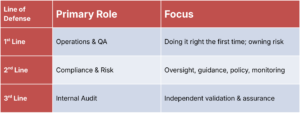
First Layer — Operational QA: Claims adjusters and underwriters performing their work against built-in quality standards. Individual performance is tracked, scored and developed in real time. This is where quality is created and where issues can be identified.
Second Layer — Internal Quality Oversight: A dedicated QA function that audits the first layer, identifies trends, surfaces systemic issues, and translates individual file data into organizational intelligence. This layer is where root causes are diagnosed and where corrective action is initiated.
Third Layer — Compliance and Regulatory Interface: The function that translates QA data into regulatory confidence, maintaining documentation, managing examination readiness, and demonstrating to regulators and leadership alike that the organization has a functioning, data-driven quality culture.
When all three layers operate with consistent processes and good data, carriers have genuine visibility into their own performance and the ability to act on it decisively, before issues escalate internally or externally.
Athenium delivers AI-driven capabilities to Elevate QA Programs
Proactive quality assurance has always required strong data, consistent processes, and skilled people. AI is now extending what QA teams can accomplish with all three. Athenium is actively integrating generative AI capabilities into its platform, enabling QA leaders to surface insights faster, focus attention where it matters most, and connect file-level findings to the systemic patterns that drive real operational change.
QA teams, with their rich structured and unstructured data sets and deep process expertise, are among the best-positioned functions in any carrier organization to lead this transition. Here’s what that looks like in practice:
Risk-Based File Selection
Not every file carries the same quality risk or learning value. Athenium’s solutions can evaluate file characteristics (claim type, handling timelines, documentation completeness, adjuster actions, and communication patterns, etc.) and surface the files where a QA review will be most impactful. This moves QA teams beyond random or volume-based sampling toward targeted, risk-stratified audits that generate more meaningful findings and more actionable coaching data.
Automated Root Cause Linkage
One of the hardest problems in QA analytics is reliably connecting individual file findings to systemic root causes and then connecting those root causes to the operational and regulatory risks they represent. AI-powered analysis can process large volumes of audit findings, identify behavioral and documentation patterns across files, and automatically classify issues into meaningful categories: untimely handling, documentation deficiencies, inconsistent coverage determinations, inadequate communication practices, and more.
QA leaders are using Athenium’s solutions to access a real-time picture of which patterns are emerging, which teams carry the highest concentration of risk and where process improvements will have the greatest impact on quality outcomes and regulatory readiness alike.
NLP for Unstructured File Content
Some of the most important quality signals in a claims or underwriting file live in unstructured content such as adjuster notes, coverage denial rationale, claim correspondence, and policyholder communications. These are sources that traditional QA tools could not evaluate at scale. Athenium’s next-generation QA capabilities utilize LLMs and natural Language Processing to enable the platform to read, interpret, and assess unstructured content against configurable quality and compliance standards.
This means QA reviewers spend less time manually searching file notes for red flags and more time acting on findings the system has already identified and prioritized. It also means that subtle patterns, such as vague denial language, delayed follow-up communications, and inconsistent handling of a recurring coverage question, are caught early, before they affect policyholders or register in complaint data.
Predictive Quality Monitoring
As operations intelligence rapidly accumulates within carriers who have deployed AI-augmented QA programs, the most powerful application of AI in QA will be predictive: using historical audit data, complaint trends, and performance patterns to model where quality risks are developing before they compound into operational or regulatory problems. By correlating internal QA findings with MCAS benchmarks and line-of-business trends, AI-assisted monitoring can surface early warning signals, such as a rising concentration of complaints in a specific region, an emerging documentation gap within a particular team, or a shift in claims timeliness that warrants immediate attention.
This shifts the QA function from a measurement role to a genuine early-warning and risk-management capability, giving QA leaders and senior management the ability to intervene early, direct resources proactively, and maintain consistent quality performance that protects policyholders, supports business results, and demonstrates organizational integrity to every stakeholder.
Athenium: Best-in-Class QA solutions for Proactive Insurance Teams
For more than 20+ years, Athenium has been the trusted partner for insurance organizations that take quality seriously. With a proven track record with more than 35 of the top 100 insurance companies, our solutions are purpose-built for the operational realities of insurance QA — not adapted from generic platforms.
teamthink is the industry-standard platform for measuring quality and developing claims, underwriting and operational performance. Purpose-built for insurance, teamthink delivers reliable, actionable data across team and individual performance metrics, enabling QA leaders to identify critical quality issues, direct coaching where it is needed most and drive continuous improvement at every level of the organization.
GaugeQuality is Athenium’s newest insurance quality solution — a modern SaaS platform delivering a range of audit and analysis tools insurers need to improve claims and underwriting performance. Built on 20 years of industry best practices, GaugeQuality offers configurable questionnaire management, rule-based file sampling, root cause analysis, interactive dashboards, individual and team performance tracking, and a single platform across all lines of business. It is designed for rapid implementation and the scalability that evolving QA programs require.
Today, these platforms give QA leaders everything they need to build and sustain a proactive quality program that performs well internally, withstands external review, and creates lasting value for the organization and the policyholders it serves.
Athenium continues to build and deliver innovative solutions, including the next generation of QA solutions. No longer will carriers be limited in reviewing 1-2% of their book of business with limited resources. Athenium’s next-generation solution merges AI capabilities with industry expertise to deliver real-time, full-scale auditing capabilities, bringing QA into the front lines with prescriptive, automated, and proactive capabilities.
Join Us in Charlotte – two opportunities to hear from Athenium!
If you’re attending IRES 2026, join us Monday, April 13, at 2:30 PM for “Quality Assurance in the Fast Lane: Strengthening Compliance Practices.” We’ll walk through the Three Layers of Defense Framework, discuss how AI is expanding the capabilities of proactive QA programs, and share practical strategies for building the kind of quality culture that delivers results — in examinations and everywhere else.
On Tuesday, April 14, at 12:30 PM, for “Quality Assurance as a Compliance Advantage in the era of AI,” where we will demo Athenium’s next-generation QA solution, highlighting its capabilities to automate quality assurance at scale, focusing on compliance and regulatory root causes and issues that are impacting carriers today and mitigating tomorrow’s operational risks.
We look forward to seeing you in Charlotte.
Want to learn more before the event? Visit athenium.com/quality to explore Athenium’s QA solutions or contact us to schedule a conversation with our team.